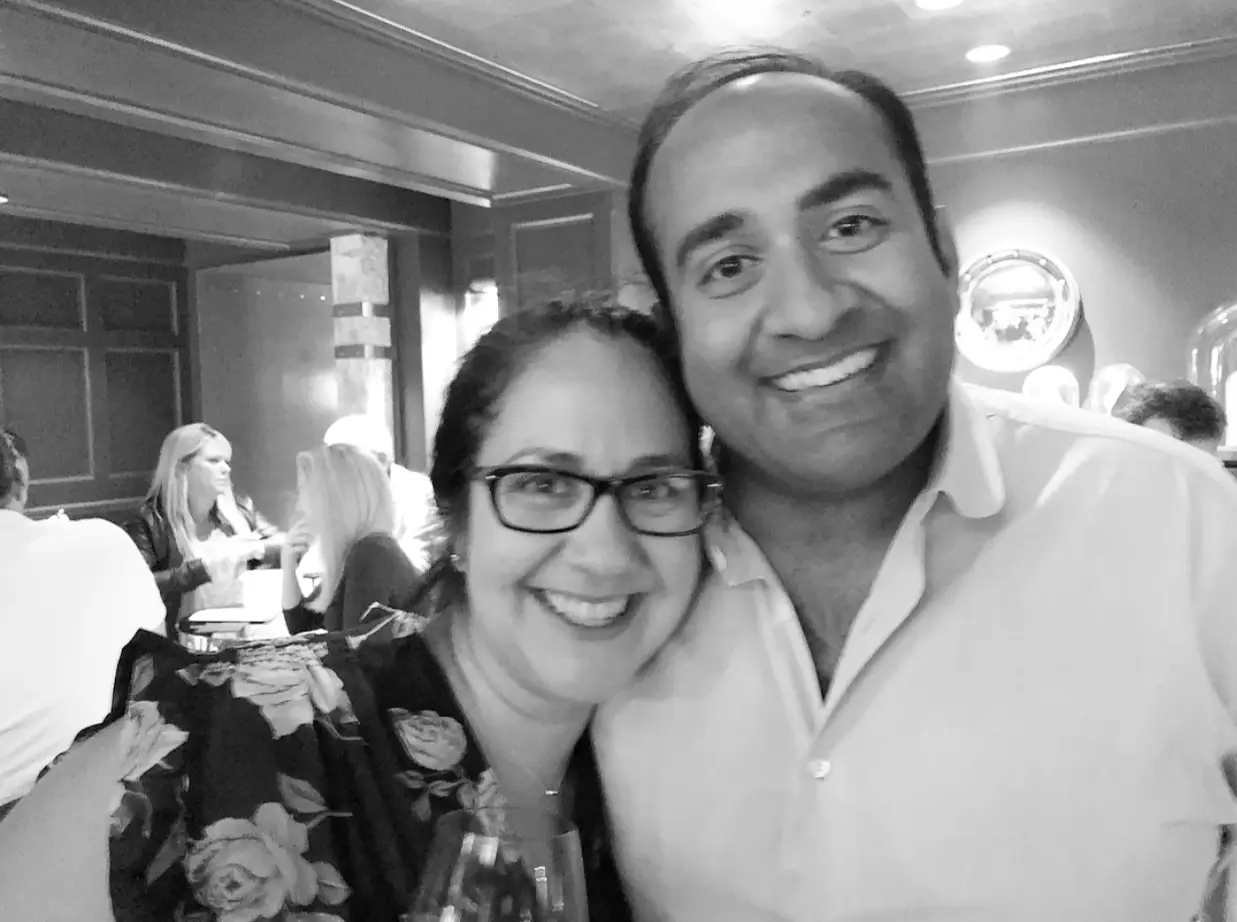
I had the pleasure of seeing Rohit Bhargava speak a year ago at a SocialMedia.org conference for global brands in Orlando. It was fascinating to hear him eagerly explain trend curation and how to apply trends to your career, business, or organization.
He showed us photos of the process he uses to create stories and ideas, better known as his formulated Haystack Method: a compilation of quotes, notes, and content from conferences he’s attended, articles, books, and magazines he’s read.
What started as an “Influential Marketing Blog” in 2004 morphed into the first Non-Obvious Trend Report in 2011. By 2015, the trend report evolved into a Wall Street Journal Best Selling Non-Obvious book series. Hearing all of this and seeing how his brilliant and innately curious mind worked, I knew I had to meet Rohit in person and learn more.
Later that evening during a conference networking event, I was able to sit down and talk with the brains behind the operation over a tasty Malbec, or two. I quickly found myself in the company of one of the most genuine people I’d ever met. He had discovered a way to stand out from the noise and tap into predicting the future of business and marketing when no one else was, a man on a mission to teach and help the world to see things non-obviously.
I stayed in touch with Rohit after the conference and was ecstatic to be hand-selected to join his early access list to Non-Obvious 2019 before it went to print or hit the shelves. Talk about VIP status!
Once I received digital access to the book (available in digital and print), I jumped right into the perfect reading material over the holidays. Truth be told, this was the first digital book I’d ever read and I finally put the fancy spin feature to use on my Samsung Notebook. Although, there’s nothing better than a good ol’ fashion book which you’ll learn more about when you read this year’s Non-Obvious in #DeliberateDowngrading.
Knowing I advantageously had my hands on one of the most sought-after annual predictions about trends in the world before the masses was like eating the last piece of cake in the kitchen, in the dark. Doesn’t everyone do this? I had a sneak peek at all the game-changing content for the year which made the read extra special. In true form of how we met, I will also note the book pairs well with a delish Malbec, or beverage of your choice.
I recently had a chance to speak with Rohit about Non-Obvious 2019 and his year so far.
Otherwise, here’s a sneak peek of our chat.
Gillette kicked off 2019, making an impact with their “Boys Will Be Boys” campaign and made headlines again post-Super Bowl with Tom Brady’s “shave-down” for charity. In Non-Obvious 2019, you acknowledge Gillette for their #EnterpriseEmpathy efforts and they proved you right in the first two months of the year. Why has it become essential for brands to drive innovation by-way of empathy?
I think the simple reason is we’ve talked about empathy for a long time. But for many years it was kind of a leadership principle. It’s like, ‘Oh if you’re going to be a CEO or CMO you need to have empathy.’ Now, I think what’s happened is more and more companies have found that there’s a business model behind empathy. And actually, if you do it well it helps you make money. Brands are starting to realize that, ‘Look, this isn’t just a nice-to-have leadership principle. It’s actually a method of thinking about the products and services that we offer. If we can bake empathy into them, they actually sell better’ and I think that’s really important.
Digital detoxes are becoming more common for overall mental health among celebrities and us normal folk. Select venues, hotels, and restaurants are offering incentives to consumers for not using their Wi-Fi and retreating to tech-free havens. Do you think #DesperateDetox is an essential piece for today’s work-life balance?
I think the important part about Desperate Detox when I wrote about the trend was the desperate part. I don’t think anyone wants to be desperate or be in a desperate situation. I think a lot of times when we turn our phones off, put them away in the box, or we get off of Wi-Fi it’s just out of this moment of, ‘Uh I can’t take it anymore, I’m fed up, I’m overloaded, I can’t deal with it so I’m desperate for a solution.’ A shift I would love to see with this trend is more people finding the balance that doesn’t require us to get to that point of desperation. Before we finally say, ‘Oh man I need balance.’ It would be much nicer to have the balance all along.
In Non-Obvious 2019, you talk about brands that are successful at capturing consumers attention with #StrategicSpectacles. The Museum of Ice Cream has become a huge sensation in the states offering colorful picture-perfect settings for the ultimate selfie. In a “do it for The Gram” driven society, what advice can you give brands looking to use spectacles to drive high engagement in a crowded media landscape?
I think that the strategic part of this is really important because you can create a spectacle that just drives a lot of attention but it doesn’t really create much value for the brand. The other way, which I think is much more effective, is to say, ‘Look we want to drive spectacle because we need to do something spectacular in order to capture attention. But once we have the attention, we’re going to use it for something purposeful. We’re going to introduce somebody to a new series, a new product line, we’re going to bring them in to experience what we have to offer.’ These are the ways that a spectacle can then turn into attention that becomes valuable.
I love, love, love that you gave Tupac a shout-out for being a holographic celebrity in Non-Obvious 2019 under #ArtificialInfluence. Would you pay to see Tupac or Biggie digitally resurrected in concert?
Yeah, why not! I mean how cool would that be?
I know you’ve had a busy year so far with a lot of speaking gigs. So, I’m sure your speaking team stays busy with keeping you busy.
They do, yes, ha! And I enjoy it. I am not the sort of speaker that gets on a stage, speaks and then jumps on a plane to get away from people as quickly as possible. I like to stick around, I go out, have drinks, I answer questions. That’s part of what I believe what a great speaker should do.
Yes, I agree. That’s actually how you and I met in Orlando last year at a SocialMedia.org conference. You were very personable, you gave an awesome presentation, and you attended the networking event that evening. It was really fun getting to know you and have some wine with you as well.
Yeah, you too! I do this weekly email newsletter that people sign up for and one of the questions on there is ‘How did you hear about this newsletter?’ We had an option on there saying ‘I had a drink with Rohit,’ and you’d be amazed how many people chose that option. Which I took to be a positive affirmation that I’m doing something right having drinks with this many people. Rather than just coming back and saying, ‘Hey, we want to get your email.’
There you have it, folks. Non-Obvious 2019 is a must-read leadership book packed with useful research, data, facts, and proven examples that will teach you exactly how to predict trends and apply them in the workplace. Grab a copy for yourself and everyone on your team, follow Rohit on social (LinkedIn, Twitter, Facebook, Instagram, YouTube), see him speak at a conference, and subscribe to his Non-Obvious newsletter where he filters through the noise of weekly top headlines for you, too. You can also check out my Amazon review for Non-Obvious 2019 here.